OmniHuman2
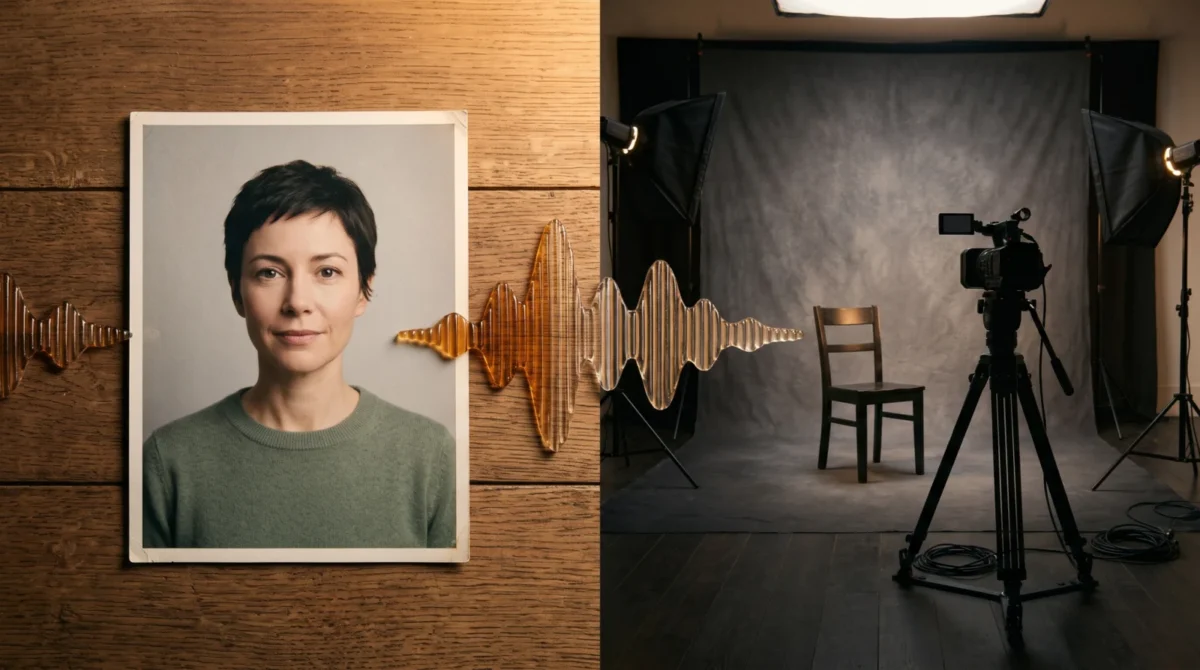
OmniHuman 2.0 vs SadTalker is a choice between a paid, directed video workflow and a self-hosted talking-head workflow. BytePlus says OmniHuman 2.0 takes an image with audio and can use an optional text prompt; SadTalker’s project describes one portrait plus audio. Pick the shot you need before comparing the price tags.
The difference in the shot
A straight-to-camera voiceover with a nearly static face is one job. A character pointing at something off frame while the camera shifts is another. BytePlus describes gesture and camera control through OmniHuman 2.0’s text prompt, plus multi-person scenes. Its product page also lists native 720p output. Those are specifications. They aren’t a guarantee.
The SadTalker project’s own README calls its core workflow a portrait image plus audio producing a talking-head video. It also documents a --still --preprocess full option for a full-image result. That option is easy to misread: a fuller frame isn’t the same as a documented instruction system for directed gestures or camera moves. If the brief says “have the speaker pick up the cup,” don’t assume either tool will manage the interaction merely because it accepts a photo.
| Decision point | OmniHuman 2.0 | SadTalker |
|---|---|---|
| Starting material | BytePlus: image plus audio, with optional text prompt | Project README: portrait image plus audio |
| Motion direction | BytePlus describes text-prompt control for camera and gestures | README documents talking-head modes and full-image preprocessing; no equivalent prompt-control workflow is described there |
| Delivery | BytePlus lists an API and console | Project README provides local setup, web UI and command-line instructions |
| Price model | BytePlus lists per-second film-grade and avatar rates | Project repository publishes code under Apache 2.0; running it still uses your own compute |
| Output claim | BytePlus lists native 720p | Don’t substitute a hosted demo’s export settings for the project’s own documentation |
This is a workflow comparison, not a quality ranking. No controlled test sits behind the table. If mouth accuracy is the deciding factor, inspect a short clip from each with the same authorized portrait and the same audio; read our OmniHuman 2.0 lip-sync guide for what to check at consonants and pauses.
Count the seconds, then count the retries
BytePlus lists $0.07 per second for OmniHuman 2.0 film-grade generation and $0.12 per second for its avatar tier. A 60-second film-grade piece is 60 s × $0.07 = $4.20; the same duration at the avatar rate is 60 s × $0.12 = $7.20. BytePlus advertises 30 to 300 seconds of video output on the film-grade tier, so don’t price a 12-second spot at the film-grade rate as if that length were documented there. The full pricing guide walks through the tier distinction.
One take rarely covers the budget. If you reserve three 60-second film-grade attempts, the listed generation rate makes that 3 × 60 s × $0.07 = $12.60, before any editing or other costs. That’s a planning allowance, not a claim about how many attempts the model needs. Record the actual generated durations and charges in your account rather than treating this estimate as an invoice.
SadTalker’s repository is publicly available under its Apache 2.0 license; a local installation doesn’t have a fixed per-second vendor rate in that repository. The code still has a cost. You supply hardware. You also own the setup and maintenance. For a few test clips, I’d budget my time before declaring the open-source route cheaper. If you already have an equipped machine and repeat the same format often, that calculation changes.
A fair test brief for both tools
Use material you own or have permission to animate. Start with one well-lit, front-facing portrait, a closed-mouth neutral expression and a clean voice recording that begins after a beat of silence. Keep the wording identical between versions. Change either input and the comparison gets muddy.
- Make a short excerpt from the real script with a pause, a sharp consonant and a sentence ending. Save the unaltered reference audio for both workflows.
- For SadTalker, follow the repository’s setup and inference instructions. Its CLI example pairs
--driven_audiowith--source_image; the result is saved under a results directory. Record which preprocessing and enhancement settings you chose. - For OmniHuman 2.0, follow the step-by-step access and creation guide. BytePlus describes image and audio as inputs with an optional text prompt. Begin with a restrained prompt, such as “Speaker faces the camera; slight head turn during the final sentence,” rather than a long list of actions.
- Watch both exports at normal speed and again without sound. Mark the exact second where the mouth, head or framing does something you cannot ship. Then compare the work needed to fix it, not an attractive still frame.
Don’t turn this into a beauty contest on one lucky render. Save your source image and audio beside the settings you used. Otherwise, you can’t tell what changed. Need a real camera move? Put it in the brief now. Clean lips cannot rescue the wrong shot.
Pick based on the deliverable
SadTalker is a sensible candidate for an engineer making repeated face-forward speech clips who is willing to own the install. Start with its README and license. Check any other assets and dependencies you add to your pipeline on their own terms; the repository license doesn’t settle every downstream permission question.
OmniHuman 2.0 is the stronger fit on paper when the creative brief calls for directed body motion, camera behavior or multiple people, because BytePlus explicitly lists those capabilities. The model’s product page doesn’t document supported speech languages, regional availability or commercial-use terms in enough detail to settle a production contract. Check those details with the provider before accepting client work, and read the OmniHuman 2.0 overview if you want to make a video there.
For a portrait-based job, write the shot as a one-line acceptance test before rendering: “One chest-up speaker stays on camera, says the approved line and ends with a clean closed-mouth pause.” That sentence will catch more wasted iterations than another paragraph of style adjectives.